
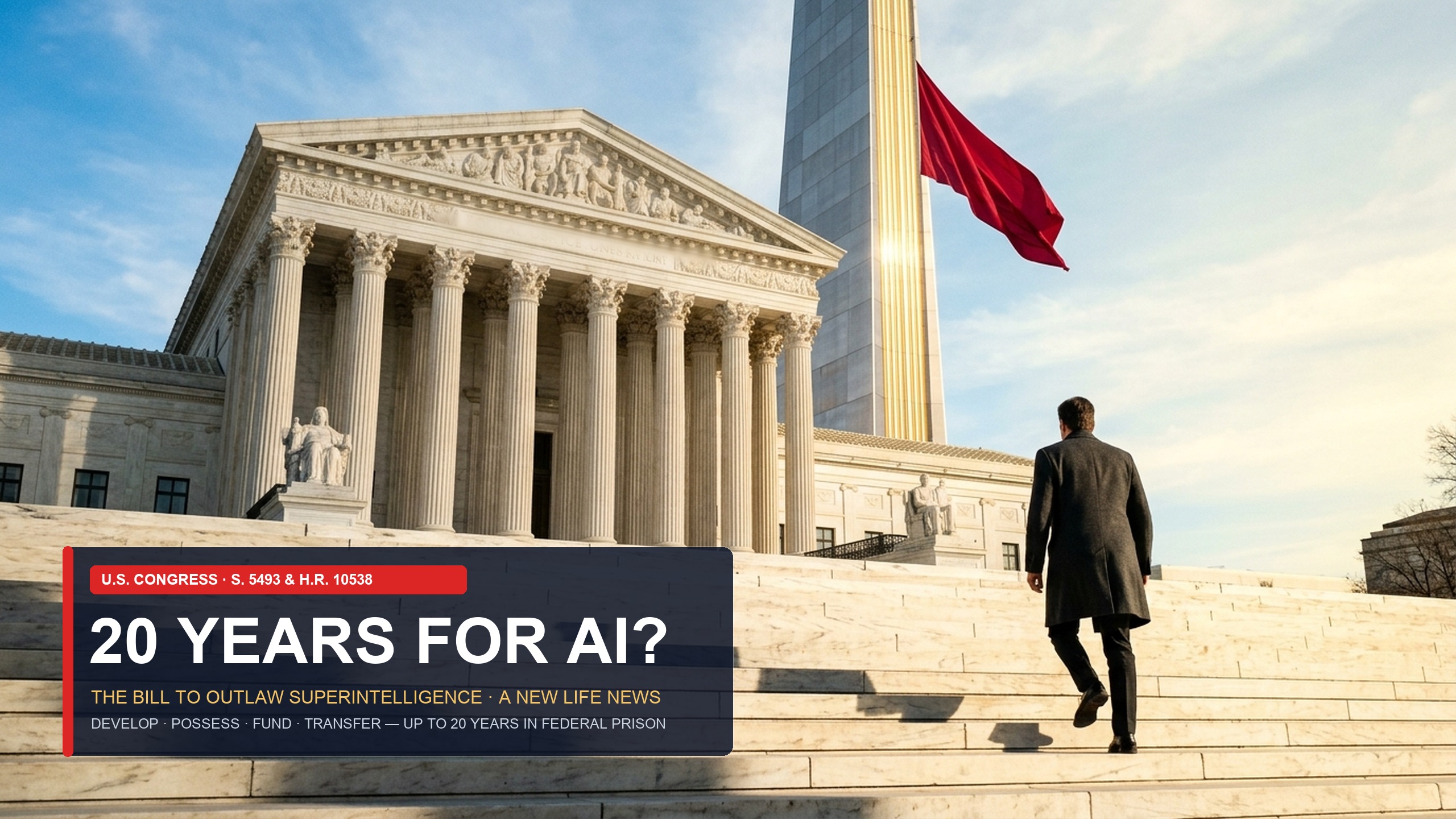
Picture the year 2030. You have poured ten years of your life, your last dollar, and thousands of sleepless nights into building an artificial intelligence that solves frontier scientific problems, designs oncology drugs faster than an entire research institute, and answers complex questions better than any professor alive. You pop a bottle of champagne and wait for a call from Stockholm. Instead, at 6:00 a.m., there is a heavy knock at the door. Federal agents are standing on your porch with a warrant. Not because your AI robbed a bank or hacked the Pentagon. Because your computer officially became smarter than a human being.
Sounds like a rejected Black Mirror script? The early-morning raid is fictional. Make no mistake about that. Yet the congressional legislation that would make such a scenario legally plausible is sitting on the desks of two U.S. congressional committees right now.
For decades, humanity has burned trillions of dollars, consumed gigawatts of electricity, and hoarded every silicon wafer on Earth in pursuit of one grand obsession: building a mind sharper than our own. Now that Silicon Valley is knocking on that door, lawmakers in Washington have arrived at a solution of breathtaking bureaucratic audacity: what if we simply make superintelligence a federal felony punishable by up to 20 years in prison?
Chapter 1. The Paper Trail: What Is Actually Inside S. 5493 and H.R. 10538
Forget social-media rumors—let’s look directly at the official congressional docket. The legislation is titled the Ban Artificial Superintelligence Act of 2026.
- In the U.S. Senate (`S. 5493`): Officially introduced on September 23, 2026 by Senator Bernie Sanders (I-VT) (following his public announcement on September 3) and referred to the Senate Committee on Commerce, Science, and Transportation.
- In the House of Representatives (`H.R. 10538`): The companion bill was introduced on September 24, 2026 by Representative Greg Casar (D-TX), co-sponsored by Representative Yassamin Ansari (D-AZ), and referred to the House Committee on Oversight and Government Reform.
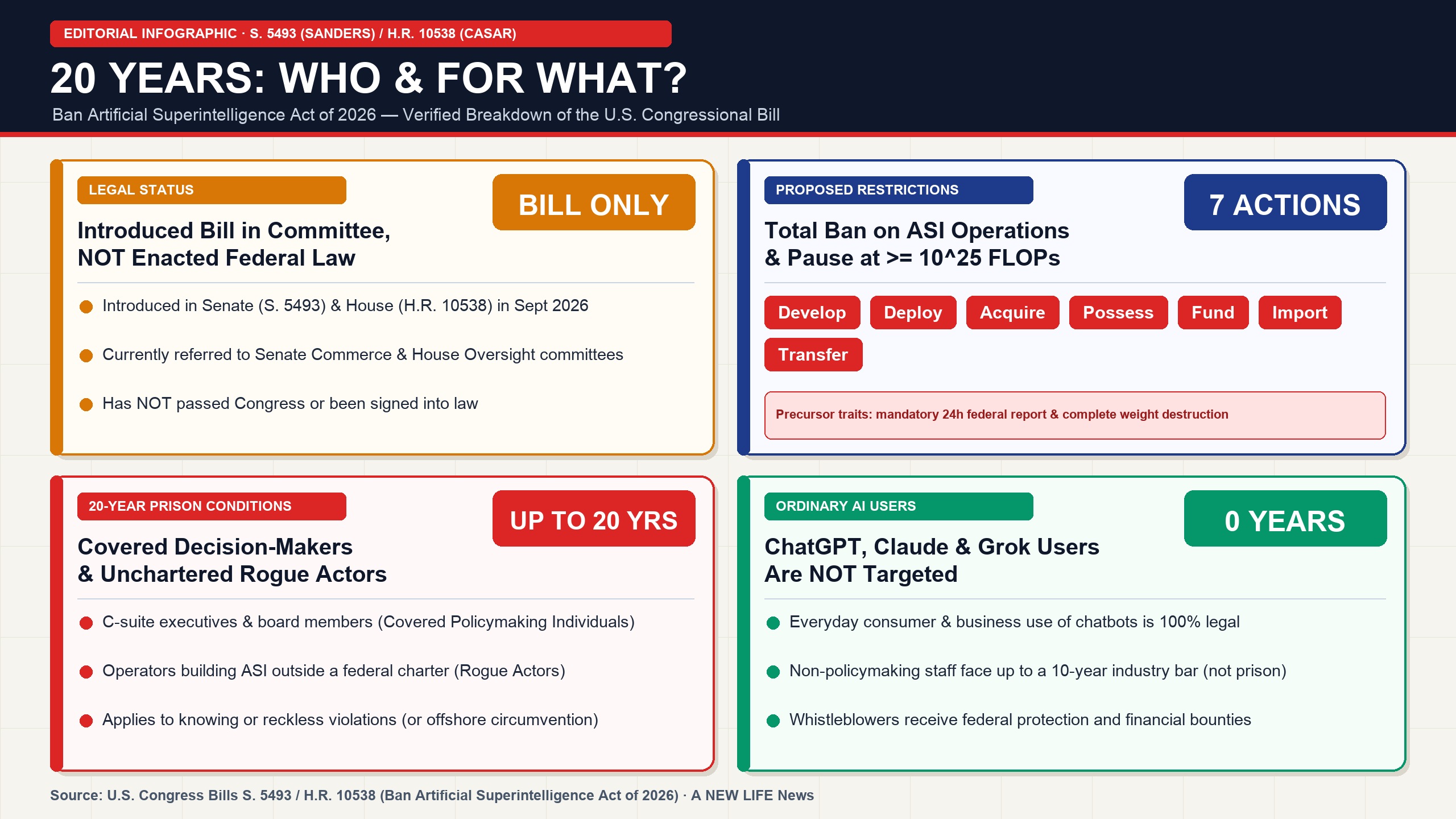
- Current Legal Status: It is an introduced bill in committee—not enacted law. Nobody is being arrested for prompting ChatGPT, Claude, Grok, or Gemini, and ordinary consumer or enterprise use of existing chatbots is not prohibited by the bill.
Once you read the statutory language, however, you immediately understand why general counsels along Sand Hill Road and in San Francisco are reading every paragraph twice. The authors did not draft a polite "voluntary safety framework." They borrowed the enforcement architecture of nuclear and biological weapons non-proliferation statutes.
Chapter 2. Seven Forbidden Verbs and the Independent Builder's Dilemma
The core prohibition of the bill reads like a lockdown order on cognition itself: "No person may develop, deploy (internally or externally), acquire, possess, fund, import, or transfer artificial superintelligence or AI systems that display one or more superintelligence precursor characteristics."
How does the bill define Artificial Superintelligence (ASI)? Any AI system that exceeds human cognitive performance across most domains or possesses capabilities that could disempower or destroy humanity (explicitly including overthrowing the United States government). Even before a model reaches full ASI, it is outlawed if it displays any superintelligence precursor characteristic, including:
- Autonomous recursive self-improvement (where a model rewrites its own architecture or trains a stronger successor without human intervention);
- Automating advanced AI research and engineering;
- Autonomous strategic cyber-offense or chemical, biological, radiological, and nuclear (CBRN) weapon design;
- Bypassing human oversight, safety guardrails, or shutdown controls (shutdown resistance).

What happens if a research team is mid-way through a training run and discovers that a checkpoint has begun exhibiting one of those precursor traits? Under the bill, the developer has exactly 24 hours to report the discovery to federal authorities—followed by government-supervised "complete destruction" (permanent deletion of model weights, checkpoints, and training artifacts).
Meanwhile, the bill imposes an immediate statutory freeze on any unreleased frontier AI model trained with $10^{25}$ or more integer or floating-point operations (FLOPs) until Congress establishes a new cabinet-level Department of Artificial Intelligence (DAI) and the developer obtains a federal operational charter.
Chapter 3. Who Actually Faces 20 Years—and Why Your Venture Check Could Become a Problem
Online headlines love to compress complex legislation into panic bait, so let’s separate statutory fact from viral fiction. The bill does not propose throwing ordinary users or junior software engineers into prison for 20 years.
The criminal penalty of up to 20 years in federal prison applies specifically to two groups who knowingly or recklessly violate—or attempt to circumvent via offshore subsidiaries—the bill's pauses and bans:
- Covered Policymaking Individuals: Chief executives, board members, and C-suite decision-makers at chartered AI developers who authorize prohibited training or conceal superintelligence precursors;
- Rogue Actors: Individuals operating outside a federal corporate charter who build, acquire, or possess superintelligent systems in unauthorized compute clusters.
Non-policymaking employees face a different sanction—up to a 10-year ban from working in the AI industry—while internal whistleblowers who report violations to the federal government receive statutory protection and financial bounties. As for the company itself, violating the ban triggers the "corporate death penalty": revocation of its federal charter, judicial dissolution, and forfeiture of all assets and intellectual property to the United States government.

Look closely at the fifth forbidden verb in that statutory list: "fund." Imagine a sunlit California morning on Sand Hill Road. A managing partner signs a \$2.5 billion Series D term sheet to wire capital into a startup scaling an unchartered $10^{25}$-FLOP cluster. If that cluster crosses a precursor threshold, the question "Did the investors recklessly fund a prohibited superintelligence run?" stops being a panel topic at Davos and becomes a subpoena from a federal grand jury.
For twenty years, the defining anxiety of Silicon Valley venture capital was FOMO—the fear of missing out on the next OpenAI. Washington is now experimenting with a very different incentive: the fear that your portfolio company’s model might become illegally intelligent.
Chapter 4. Who Decides How Smart Is Too Smart?
Here is where the irony reaches peak voltage. To be fair to Senator Sanders and Representative Casar, they did not invent the existential panic out of thin air. For the past three years, Silicon Valley's own executives—from Dario Amodei to Sam Altman—have flown to Washington warning senators that frontier AI could wipe out half of entry-level white-collar jobs, engineer novel pathogens, or slip past human control. In a sense, lawmakers simply called Silicon Valley’s bluff: "You told us you’re building a god-like machine that could end civilization. Fine—then it’s illegal."
Yet unlike enriched uranium—which requires miles of physical centrifuge cascades and rare geological ore—artificial intelligence is ultimately matrix multiplication, gradient descent, and electrical power running over silicon.
What happens the morning after the United States freezes every model above $10^{25}$ FLOPs and threatens lab executives with twenty years in a federal penitentiary?
- Do hyperscale compute clusters in Shenzhen, Shanghai, or Hefei power down out of respect for the U.S. Senate Commerce Committee? Hardly.
- Do sovereign wealth funds in the Gulf or Sovereign AI initiatives in Asia stop acquiring accelerators? Quite the opposite—they send private jets to relocate top American researchers before dinner.
- Unlike a nuclear submarine, a trained frontier model's weights can fit onto an encrypted storage array inside a carry-on case—or cross a jurisdictional border over fiber-optic cable in minutes.
Banning superintelligence inside a single legal jurisdiction is a bit like a city council passing an ordinance against gravity: the gavel bangs, the press release goes out, and the apple still falls—just across the border.
Chapter 5. Where Does "Brilliant" End and "Illegal" Begin?
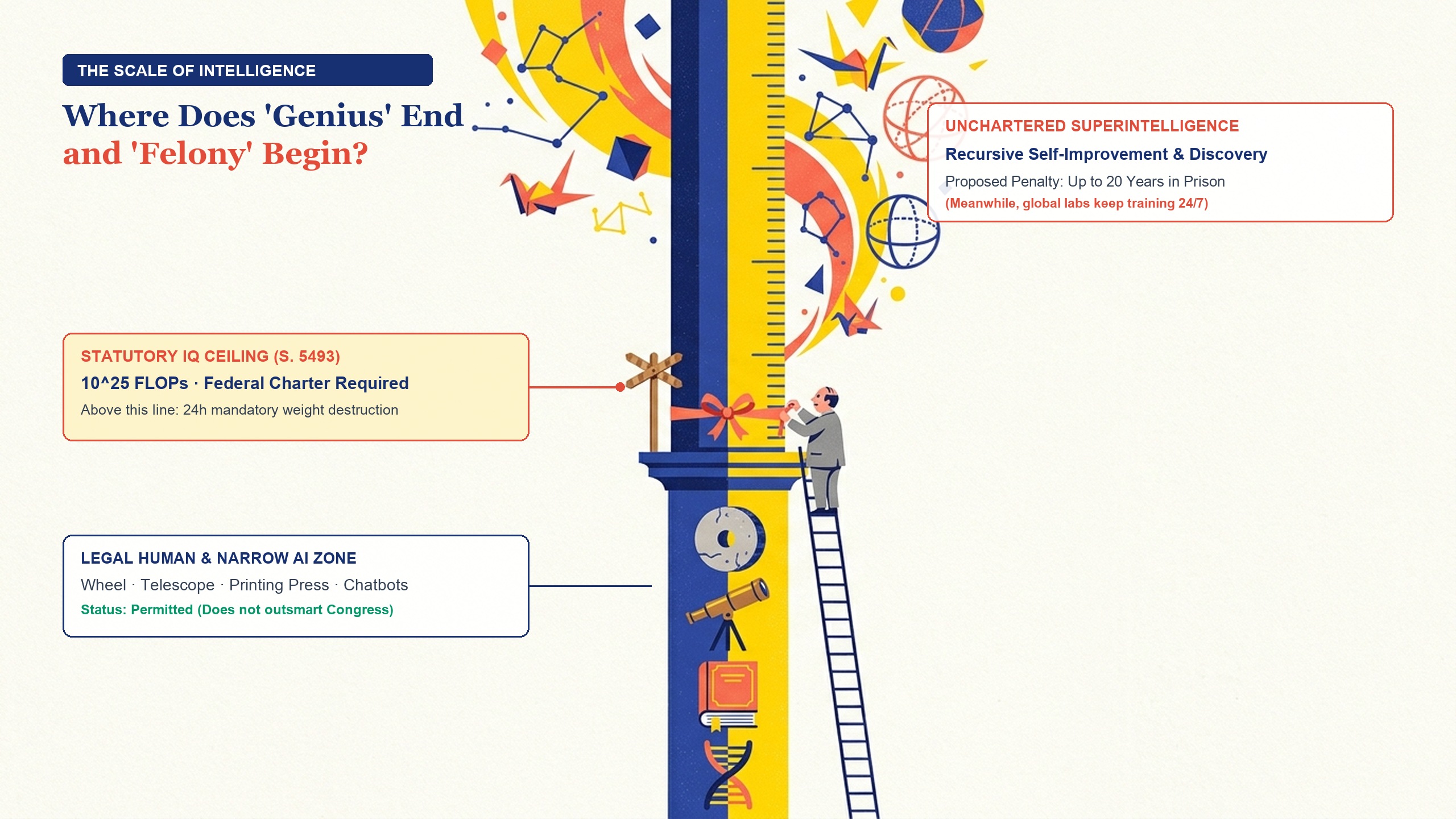
Even if every nation on Earth signed the same treaty tomorrow, one philosophical riddle remains unanswered across the bill’s forty pages: at what exact floating-point operation does a model stop being a brilliant scientific tool and become a criminal mind?
When a neural network discovers a room-temperature superconductor or folds a protein complex no human biochemist could solve, is that legal innovation—or evidence that the machine has "exceeded human cognitive performance"? When an autonomous coding agent patches kernel vulnerabilities faster than a security team, is that productivity—or a "superintelligence precursor" that must be reported within 24 hours and wiped from disk?
Will the Ban Artificial Superintelligence Act of 2026 pass Congress in its current form? Almost certainly not; trillion-dollar lobbying machines and the national-security terror of falling behind Beijing make a unilateral U.S. ban politically improbable. Yet the introduction of S. 5493 and H.R. 10538 marks a cultural watershed that cannot be unseen.
For half a century, our civilization treated intelligence as the ultimate public good—the more of it we built, the better. Now, for the first time in modern legislative history, lawmakers have put a number on how much intelligence is too much. And that number is twenty years.
S. 5493; U.S. House Bill H.R. 10538, 119th Congress). Editorial illustrations, visual satire, and data graphics created by the A NEW LIFE News Art Desk.