
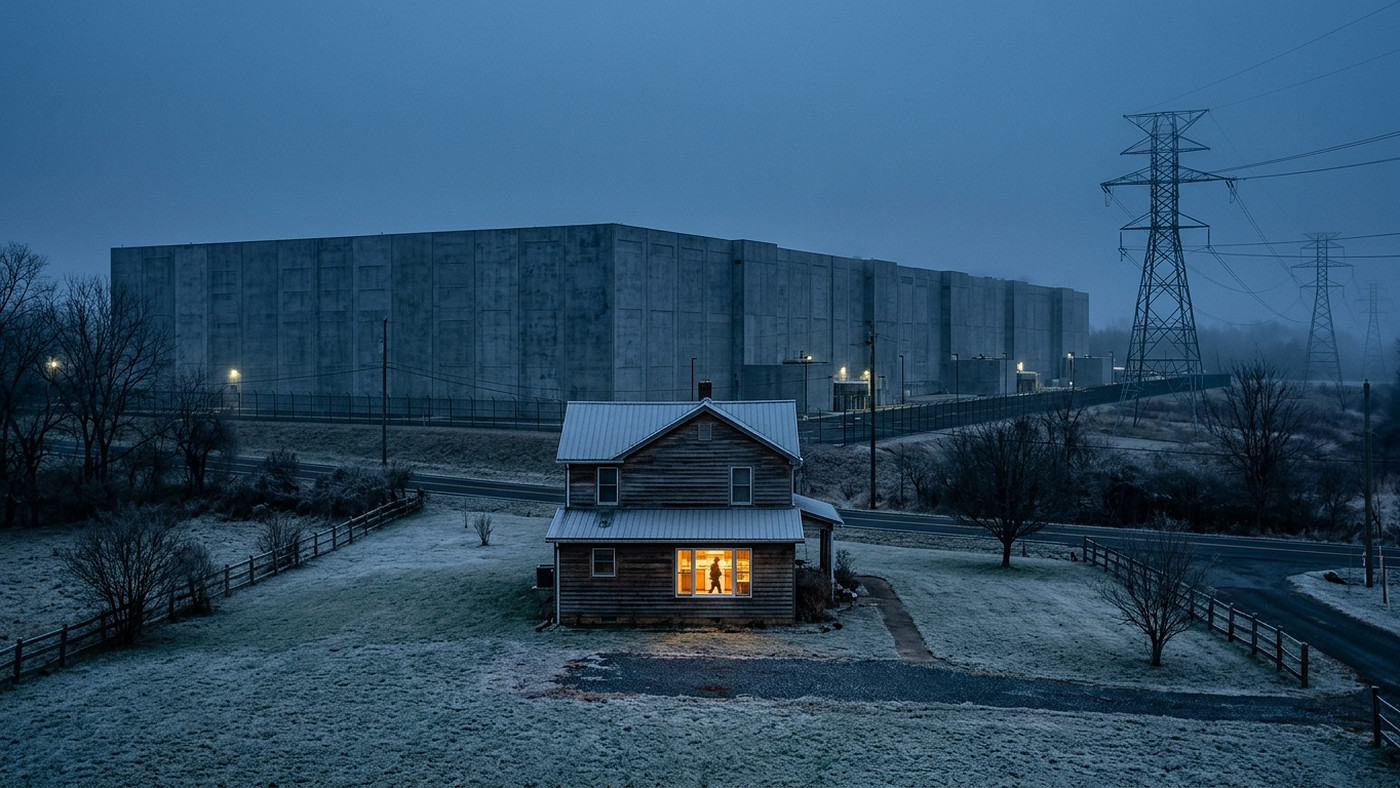
When you open an app on your phone and ask an AI model to summarize a contract, debug a script, or draft a strategy memo in three seconds, the interface feels completely weightless. The answer appears to materialize out of thin air—somewhere inside an abstract “cloud.”
Yet that cloud has a staggering physical footprint. It is built out of hundreds of thousands of tons of reinforced concrete, copper busbars as thick as a human arm, high-voltage substations, liquid-cooling loops, and gigawatt-scale power plants. And in late 2026, the financial and physical engine behind that machine has hit two simultaneous pressure points: bank balance sheets and the electrical grid.
A NEW LIFE News Video Dossier (16:9 HD with EN/RU/TR subtitles): Tracing the cost chain from $38B loan syndications and SRT deals to the 10x PJM grid capacity surge.
Part I. Confirmed Credit Facts: Why Banks Are Offloading Data-Center Exposure
Start with the verified mechanics of the debt market. During the opening wave of the generative AI boom, hyperscale data centers were funded primarily through Big Tech's massive cash reserves and traditional syndicated bank loans. For major commercial and investment banks across New York, London, and Tokyo, financing server campuses leased to trillion-dollar tech companies looked like a textbook safe bet.
Then the sheer scale of the buildout collided with bank balance-sheet math. A definingwatershed was the record $38 billion debt financing package assembled for massive data-center campuses in Texas and Wisconsin (developed by Vantage Data Centers and leased to Oracle to power frontier AI workloads). Syndicating a single construction package of that magnitude revealed that even top-tier lenders—including JPMorgan Chase, Morgan Stanley, and Japanese project-finance powerhouses MUFG and SMBC—were bumping straight into internal and regulatory single-sector concentration limits.
Risk committees began asking a sobering question: what happens to a 10-to-15-year loan backed by a specialized AI server complex in rural Texas if chip architectures shift in four years, power tariffs spike, or Wall Street forces hyperscalers to slow down their $600 billion CapEx spree?
To keep lending without blowing past risk ceilings, banks have turned to two aggressive balance-sheet relief valves:
- Discounted Secondary Loan Sales: selling off slices of data-center construction debt to non-bank institutional buyers to recycle capital.
- Synthetic Risk Transfers (SRTs): keeping the loan on the bank's books while paying private credit funds, hedge funds, and insurers 8% to 12% annual yields to absorb the first-loss credit tranche if borrowers default.
Private credit titans—Blackstone, Apollo, Brookfield, PIMCO—are eagerly stepping in with hundreds of billions of dollars. But private credit has one non-negotiable feature: it is significantly more expensive, routinely commanding 200 to 400 basis points over conventional bank loans. In short, the cost of capital required to build the physical home of artificial intelligence just went up.
“When banks pay double-digit yields via synthetic risk transfers to get data-center exposure off their balance sheets, they aren't betting against AI. They are simply making sure they aren't the ones left holding the tab if the music slows down.”
Part II. The Power Grid Bottleneck: You Can't Print Megawatts
The second half of the equation is even harder to escape, because central banks cannot print electricity. A single query to a deep-reasoning AI model or an autonomous agent consumes multiples more compute and watt-hours than a traditional keyword search. Meanwhile, a next-generation training and inference campus demands 500 megawatts to 1.5 gigawatts of continuous 24/7 baseload power—the equivalent of a city of one million homes.
What happens when that digital appetite hits aging power grids? Look no further than the capacity auctions run by PJM Interconnection, the largest electrical grid operator in the United States, serving 65 million people across 13 states and Washington, D.C. (including Northern Virginia's “Data Center Alley”).
Driven by surging data-center load forecasts and retiring thermal plants, PJM's wholesale capacity price exploded nearly tenfold—jumping from $28.92 per megawatt-day to $269.92 per megawatt-day, and subsequently hitting the $329.17 per megawatt-day cap. In plain dollars, that translates into an extra $14.7 billion in grid capacity costs across the region. PJM has already filed emergency Reliability Backstop Procurement (RBP) rules with federal regulators, effectively telling new hyperscale data centers to bring their own power generation or accept curtailment during grid emergencies.

Part III. Testing Our Editorial Hypothesis: Will the Bill Land in Your Lap?
Now let's put the verified facts together and test our central editorial hypothesis:
BANKS REDUCE EXPOSURE → CAPITAL & CREDIT GROW MORE EXPENSIVE → DATA-CENTER CONSTRUCTION & POWER COSTS SURGE → AI PROVIDERS SEEK PAYBACK → PART OF THE BILL SHIFTS TO THE END USER.
Our central question is simple: if artificial intelligence consumes ever more electricity and requires ever more expensive billions, who ultimately pays for its appetite?
In a market economy, infrastructure costs never vanish into thin air. Evidence across software pricing and utility regulation shows the bill is already reaching ordinary people through three distinct transmission channels:
- Channel 1 — Subscription Stratification ($20 → $200/month): Two years ago, $20 a month bought virtually unlimited access to the world's frontier AI model. Today, $20 buys a rate-limited standard tier, while heavy reasoning models and autonomous coding/research agents (ChatGPT Pro at $200/mo, Claude Max at $100–$200/mo, usage-billed enterprise agents) have established a new luxury price bracket.
- Channel 2 — The Invisible B2B Markup: Even if you never pay a cent for a personal chatbot subscription, your bank, airline, hospital, insurer, and SaaS providers are buying enterprise AI tokens by the billion—and baking those cloud inference costs directly into service fees and consumer prices.
- Channel 3 — Household Utility Bills: When regional utilities spend billions upgrading high-voltage transmission lines, substations, and capacity reserves to keep data centers humming 24/7, rate-regulated cost recovery spreads a substantial share of those grid upgrades across ordinary residential electricity ratepayers.
The Counter-Force: Algorithmic Efficiency vs. Jevons Paradox
To be fair, a powerful counter-force is fighting to push costs down: algorithmic and hardware efficiency. Mixture-of-Experts (MoE) architectures, model distillation, quantization, and custom ASICs repeatedly slash the cost per token for routine tasks.
Yet Jevons Paradox rules computing with an iron fist: every time a single token gets ten times cheaper, we invent workflows—like multi-step autonomous agents running 24/7 in the background—that consume a hundred times more tokens. The result is a two-tier future: basic AI chat will remain cheap or ad-supported, while frontier reasoning intelligence becomes an expensive energy and capital privilege.
Yesterday the world debated which jobs AI might replace and whether we live inside a computer simulation. Today the question is far more immediate: who is paying the electric bill for the servers running our new reality?