
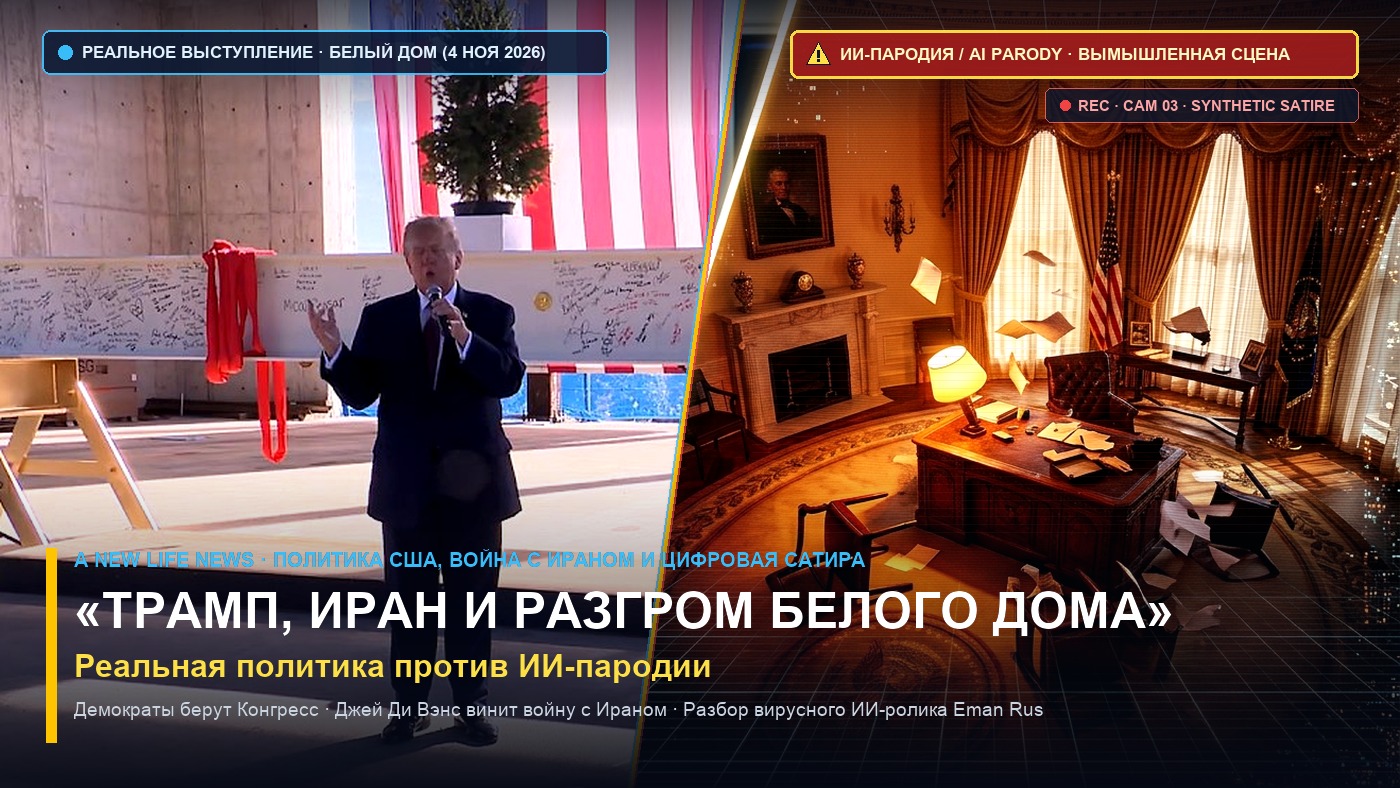
Authentic broadcast of President Donald Trump speaking at the White House structural beam ceremony on November 4, 2026. Starting at 25:55, Trump addresses the midterm loss of Congress, acknowledges the Iran war 'drove the gasoline up a little bit short-term,' insists 'you can't let Iran have a nuclear weapon,' responds to Vice President JD Vance's post, and pledges to govern with the presidential veto.
«In reality, the president was discussing the aftermath of the midterm elections. Online, his reaction had already been turned into a satirical disaster movie. The second video is generated by artificial intelligence.»
1. The November 3, 2026 Electoral Earthquake: How Democrats Flipped Both Chambers of Congress
The November 3, 2026 midterm elections fundamentally reshaped the balance of power in Washington for the second half of Donald Trump's presidency. Democrats not only recaptured the U.S. House of Representatives — surging past the 218-seat majority threshold and flipping roughly forty Republican-held districts across suburban Pennsylvania, Michigan, Arizona, and California — but also pulled off a far more consequential upset in the U.S. Senate.
Entering Election Day, Republicans held a 53–47 Senate majority that many party strategists considered structurally insulated. Instead, Democratic challengers defended their vulnerable incumbents and broke through in states that had backed the Trump-Vance ticket two years earlier — including hotly contested races in Ohio, North Carolina, Iowa, Kansas, and Texas — building a new 52-to-54 seat majority. Beginning in January 2027, President Trump will face a fully opposition-controlled Congress for the first time in his second term.
2. JD Vance's November 4 Statement on X: Dismantling the 'Low Turnout' Excuse
On the morning of November 4, 2026, as Republican operatives attempted to blame the sweep on typical midterm apathy when Donald Trump's name is absent from the ballot, Vice President JD Vance published a blunt post-mortem on X (x.com/JDVance/status/2118004988433641835) that shattered the party's conventional spin.
Vance pointed out that Republican turnout had actually been robust in key states — noting that Florida's electorate was +9 Republican by registration — yet GOP candidates still lost ground. The Vice President diagnosed a far deeper structural problem: "The main problem is not that Republicans stayed home. The main problem is that many people who voted for Trump/Vance in 2024 voted for Democrats in 2026."
3. The Four Voter Grievances — And Why Vance Blamed the War with Iran
In his November 4 statement, Vance cited internal polling of 2024 Trump-Vance voters who defected to Democratic candidates in the 2026 midterms. Asked what it would take to bring them back into the Republican coalition, those voters named four primary demands:
- 1. End the war with Iran (the joint U.S.-Israeli military campaign against Iranian nuclear and military infrastructure launched in February 2026);
- 2. Focus on domestic cost of living and inflation, which had been aggravated by wartime energy shocks;
- 3. Put America First rather than bankrolling open-ended Middle Eastern military commitments;
- 4. Change the U.S. relationship with Israel in the wake of regional escalation.
Vance praised Fox News host Rachel Campos-Duffy for calling for a diplomatic resolution to the conflict and warned establishment Republicans against misreading the defeat as an excuse to pass immigration "amnesty." He then delivered the line that reverberated across Washington:
"The reason we lost is the war. The president himself said so last night. If you'd like to argue it was worth it, that losing the Senate for the next 6 years was worth it, then do so. Argue it was a worthwhile cost to pay. Agree or disagree, that's at least honest. But everyone knows why we lost. And any honest conversation about where we go from here must start there."
— U.S. Vice President JD Vance, November 4, 2026 (post on X)

4. What Donald Trump Actually Said on November 4: +36% Gas Prices, Iran's Nuclear Program & the Veto
Comparing internet rumors with the official record reveals a striking contrast. In his first public appearance after the election on November 4, 2026 — a White House ceremony celebrating the final structural steel beam for the new White House ballroom (official White House video, press Q&A from 25:55 to 39:15) — President Trump spent over twenty minutes calmly discussing Corinthian architecture and White House window moldings before addressing the midterms and Iran:
- Acknowledging the Short-Term Gasoline Shock (26:01): Trump conceded that the war with Iran and shipping disruptions in the Strait of Hormuz — which drove U.S. retail gasoline prices up roughly 36% — hurt Republicans at the ballot box: "Well, I think it's largely true because it drove the gasoline up a little bit short-term... People agree with what I'm doing in Iran, but they really, probably weren't willing to do the short-term consequence of paying more for gasoline."
- Unwavering Defense of the Iran Strike (26:13 & 35:41): At the same time, Trump expressed zero regret over launching the operation: "It's the only answer. You can't let Iran have a nuclear weapon... Whether it impacted [the election] or not, Iran can't have a nuclear weapon. We stopped them from having a nuclear weapon, and they will never have a nuclear weapon."
- Insulating Himself from the Defeat (27:17): While congratulating Democrats in interviews ("Congratulations to the Democrats, they did a good job"), Trump insisted at the White House podium: "No, look, I mean, if I were on the ballot, we would have won. You saw the people that were packed, thousands and thousands of people at every rally."
- Ruling by Veto and Warning Against Impeachment (26:39 & 28:47): Addressing the incoming Democratic majority, Trump stated: "Look, I mean, I'll get along probably with the Democrats unless they want to be destructive. But I have the power of the veto," while warning that any Democratic push for impeachment "would destroy the Democrat Party if they did that."
5. Inside the Administration's Fault Line: Trump's Legacy vs. Vance's 2028 Horizon
The public divergence between the President and Vice President on November 4 exposed the sharpest strategic tension inside the administration since taking office. Asked directly by reporters at the White House beam ceremony about Vance's X post blaming the war, Trump replied measuredly — "I know how he feels about it" — while standing firm that preventing a nuclear-armed Iran outweighed six years of Senate control.
The underlying calculus reflects two different political clocks. For Trump, serving his constitutional final term, dismantling Iran's nuclear infrastructure is a defining historical legacy. For JD Vance, widely viewed as the standard-bearer for the 2028 Republican nomination, watching working-class swing voters defect over war fatigue and $4-plus gasoline represents an existential threat to the America First coalition.
6. Consequences for U.S. Domestic and Foreign Policy in 2027–2028
A Democratic-controlled House and Senate will transform Washington governance across three immediate fronts starting in January 2027:
- Congressional Oversight of the Iran War: Democratic committee chairs will wield subpoena and appropriations power to audit Pentagon war spending, demand classified briefings on exit timelines, and force floor votes on War Powers resolutions.
- Judicial and Cabinet Bottlenecks: Losing the Senate strips the White House of its ability to confirm federal judges and executive nominees without bipartisan negotiation.
- Subpoena Warfare vs. Executive Veto: While House and Senate committees prepare oversight hearings into tariffs, war conduct, and domestic agencies, Trump will rely heavily on executive orders and his presidential veto pen — a constitutional standoff neither side can easily override without a two-thirds supermajority.
7. Social Media Reaction: Where High-Stakes Geopolitics Met Instant Meme Culture
The juxtaposition of a historic midterm wipeout, a public debate between Trump and Vance over the Iran war, and the President's calm remarks about White House ballroom moldings created an immediate satirical vacuum online. Across X, TikTok, and Telegram, users joked about what must have happened behind closed doors when the networks called the Senate for Democrats — setting the stage for a piece of generative satire that went viral within hours.
8. The Story Behind Eman Rus's Viral AI Parody 'Trump's Midterm Meltdown'
On November 4, 2026, Italian digital artist and political AI satirist Eman Rus (@emanrus8469) published a satirical video titled "Trump's Midterm Meltdown | AI Parody" on YouTube.
In the clip, an AI-generated rendering of Donald Trump in his signature navy suit and red tie flies into a slapstick rage inside the Oval Office upon seeing the midterm election returns: wielding a wooden baseball bat, the synthetic figure smashes table lamps, sweeps documents and telephones off the Resolute Desk, overturns leather chairs, and swings wildly as Secret Service agents and aides rush in to restrain him. Eman Rus explicitly labeled the original upload and thumbnail with a bold red AI PARODY badge and his creator signature.
9. Why Some Viewers Mistook the Synthetic Parody for Real Footage
Despite the creator's clear disclaimer, thousands of social media users in comment sections debated whether the footage was a "leaked White House security tape." Three technical and psychological mechanisms explain why the illusion worked on casual viewers:
- The 'CAM 03' Security Camera Aesthetic: Key shots of the parody were rendered from a high-angle ceiling corner perspective mimicking closed-circuit surveillance footage (
CAM 03) without close-up spoken dialogue. That wide angle masks the two biggest tells of generative video — lip-sync drift and unnatural facial micro-expressions. - Cropped Watermarks by Viral Reposters: While Eman Rus's original YouTube upload prominently displayed
AI PARODY, engagement-farming accounts on X, TikTok, and Telegram cropped the aspect ratio, stripped the creator's credits, and degraded the video resolution to make it look like a compressed phone recording of a security monitor. - Emotional Plausibility Amid Real Political Drama: Because the midterm loss and the Trump-Vance disagreement over the Iran war were real, documented headlines on November 4, partisan audiences were primed to believe an exaggerated visual depiction of White House chaos.
The collision of November 4, 2026 illustrates the defining challenge of modern political coverage: the electoral shift in Congress and the debate over the Iran war are real and consequential, while the baseball-bat rampage in the Oval Office is pure algorithmic satire. Putting the official White House broadcast and Eman Rus's labeled parody side by side lets every reader see exactly where documented history ends and synthetic comedy begins.