
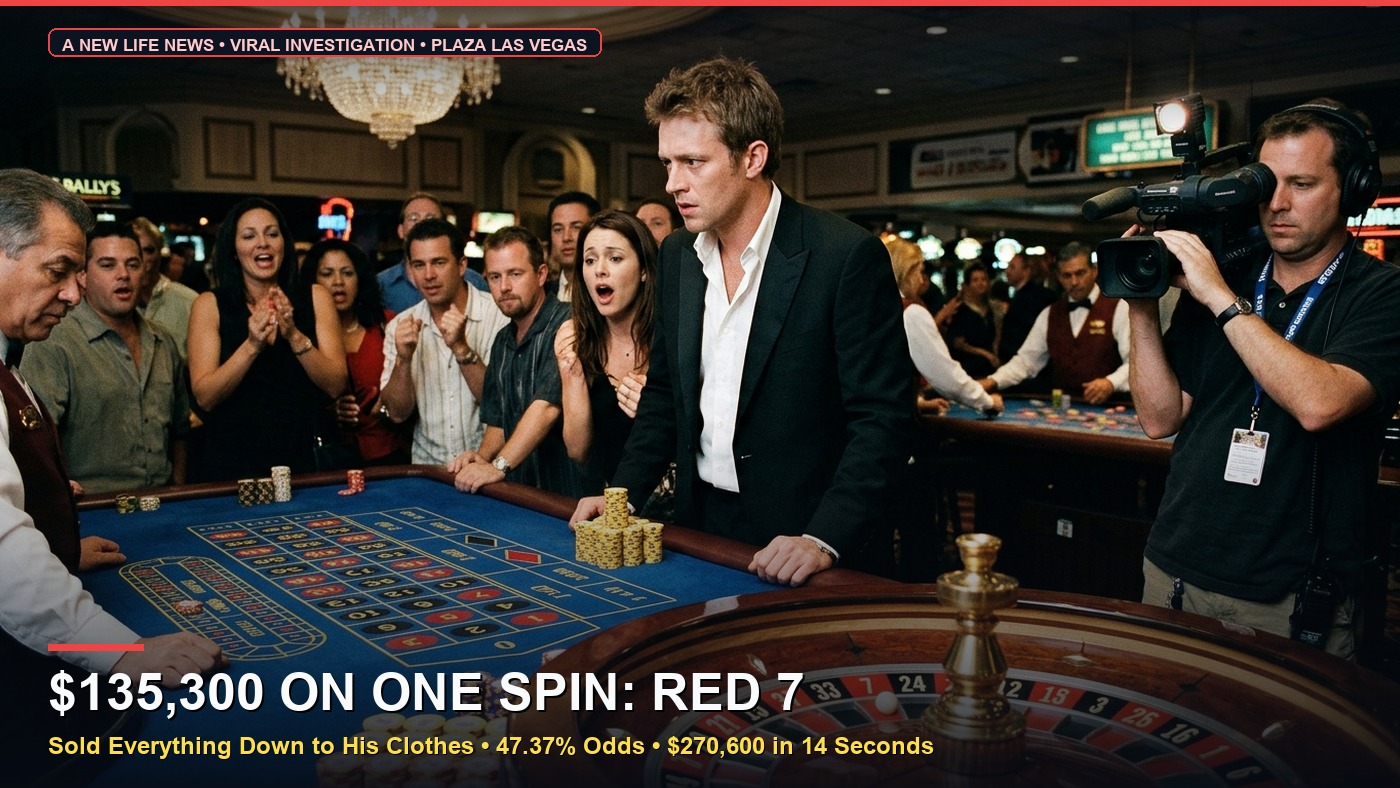
Ashley Revell risked his entire life savings at a Las Vegas casino roulette table. We found the original uncut video and investigated what happened to him after the famous bet. Over the past 48 hours, the two-minute clip has exploded across X all over again—racking up more than 7.2 million combined views across @kaienphase and @BBPP3M as a casino executive looks straight at the 32-year-old Londoner and asks: "Are you sure you want to make this bet with your life savings?"
Main Player — the uncut April 11, 2004 Sky One 'Double or Nothing' broadcast from the Plaza Hotel & Casino floor (official archive by Ashley Revell @ashling71) with original casino audio and zero watermarks.
Who Was Ashley Revell—and Why Was He Wearing a Rented Tuxedo?
The spin happened on Easter Sunday, April 11, 2004, inside the Plaza Hotel & Casino at 1 Main Street in downtown Las Vegas. The man at the table was 32-year-old Londoner Ashley Revell.
Contrary to internet rumor, Revell was neither a trust-fund heir nor an advantage gambler. In the late 1990s, he worked at British cable station L!VE TV, where his early job literally involved wearing the full-body costume of the channel's mascot—the "News Bunny"—giving thumbs-up or thumbs-down behind newsreaders. He later worked as a television researcher and celebrity booker, appearing in Channel 4's 2000 documentary When Will I Be Famous?
In late 2003, over drinks with friends at a London pub, an extreme idea took hold: liquidate every single possession he had accumulated by age 32, fly to a Las Vegas casino, and put his entire life savings on one spin of a roulette wheel. UK broadcaster Sky One commissioned a reality mini-series following the journey titled Double or Nothing.
Over six months, Revell turned his entire existence into cash:
- He auctioned off his BMW, his Rolex watch, and his golf clubs.
- He held a car boot sale where he sold his furniture, electronics, and every single item of clothing he owned.
- To boost his bankroll, he legally changed his middle name by deed poll to "Blue Square"—becoming Ashley Blue Square Revell—in exchange for sponsorship money from the British online bookmaker.
When he stepped onto the casino floor on April 11, 2004, he owned nothing on his back: the black tuxedo and white dress shirt he wore were rented for the night. His father, Mick Revell, had publicly opposed the stunt—telling reporters, "I told him he was a naughty boy, he was a bad boy, he shouldn't do it"—yet flew to Las Vegas with Ashley's mother so their son wouldn't face the table alone.
The Casino That Pulled Out—and the Two-Revolution Rule
Behind the scenes, the bet nearly collapsed hours before cameras rolled. The wager had originally been arranged with the Hard Rock Hotel and Casino, but the venue pulled out at the eleventh hour.
Downtown Vegas legend Jackie Gaughan and Barrick Gaming at the Plaza Hotel & Casino stepped in at the last minute to host the spin. Revell wired over his life savings—£76,840, which converted to exactly $135,300—and received two towering stacks of yellow $1,000 Plaza chips.
Before the croupier touched the ball, a Plaza executive delivered one of the most surreal live-television disclaimers ever recorded on a casino floor:
"We would never knowingly condone or accept someone taking a wager of their entire life savings. But we know this is a culmination of a grand adventure for you… Once the dealer picks up the ball, he will spin the ball. You must declare your bet prior to the ball making two revolutions around the track. If you declare your bet past that time, it will be a no bet."

The Cold Math & The Last-Second Switch From Black to Red
From a pure probability standpoint, placing the bet in a Las Vegas casino rather than Europe quietly stacked the odds even further against him. The Plaza table featured an American double-zero roulette wheel (0 and 00)—38 pockets in total, meaning 18 Red pockets against 20 non-Red pockets.
| Wager Metric | Verified Figure | Real-World Implication |
|---|---|---|
| Total Stake | $135,300 (£76,840) | 100% of his liquidated life savings plus deed-poll name sponsorship |
| Wheel Layout | American Double-Zero (0 & 00) | 38 total pockets (18 Red, 18 Black, 2 Green house pockets) |
| True Win Probability | 18 / 38 = 47.37% | A 52.63% chance of losing everything in 14 seconds (5.26% house edge) |
| Winning Pocket | 7 Red → $270,600 Payout | +$135,300 net profit on a single spin; $600 tip to the croupier |
Walking up to the table, Revell had intended to bet on Black. Yet when the dealer asked, "What color, then?"—Revell froze, laughed nervously, and said: "I don't know… Oh man, too many decisions."
After an aborted first throw ("No spin"), the dealer launched the ball a second time. With only two revolutions to decide, Revell went with the color Sky One viewers had voted for—pushing all $135,300 onto the Red diamond. He asked, "Can I kiss it?" leaned over the felt, and watched the ball drop into 7 Red.
What Happened to Ashley Revell After the Famous Bet
Viral clips always cut right as Revell celebrates. But what happened over the next ten minutes is why his story didn't end in ruin.
Pressed on whether he would let the $270,600 ride for half a million dollars, Revell said no. He tipped the dealer $600, collected $270,000, and walked away from high-stakes roulette forever.
- The Motorcycle & His Future Wife: Back in Europe, he bought a Triumph Tiger motorcycle and rode across the continent. On that trip, in the Netherlands, he met the woman who became his wife and the mother of his two children.
- Building Real Businesses: Rather than gambling the windfall away, he used the capital to launch an online poker company, Poker UTD, and later founded iGaming Recruitment (and in 2023 launched tech platform four.me).
- Returning to the Plaza 15 Years Later: Music mogul Simon Cowell credited Revell's 14-second spin as the direct inspiration for ITV's game show Red or Black? And in 2019—15 years after that Easter Sunday—Revell returned to the Plaza Hotel & Casino alongside CEO Jonathan Jossel for a ceremonial spin (featured in Tab 3 of our video player above).
Ashley Revell's spin is not a blueprint for beating a casino—the math was strictly against him at 47.37%, and a 52.63% outcome would have left him penniless in a rented tuxedo in front of his parents. What makes him a one-in-a-million outlier isn't just that the ball landed on 7 Red; it's that the moment luck handed him a miracle, he cashed out his chips and used the money to build a real life.
Would you have had the nerve to walk away immediately—or would you have never placed the bet at all?