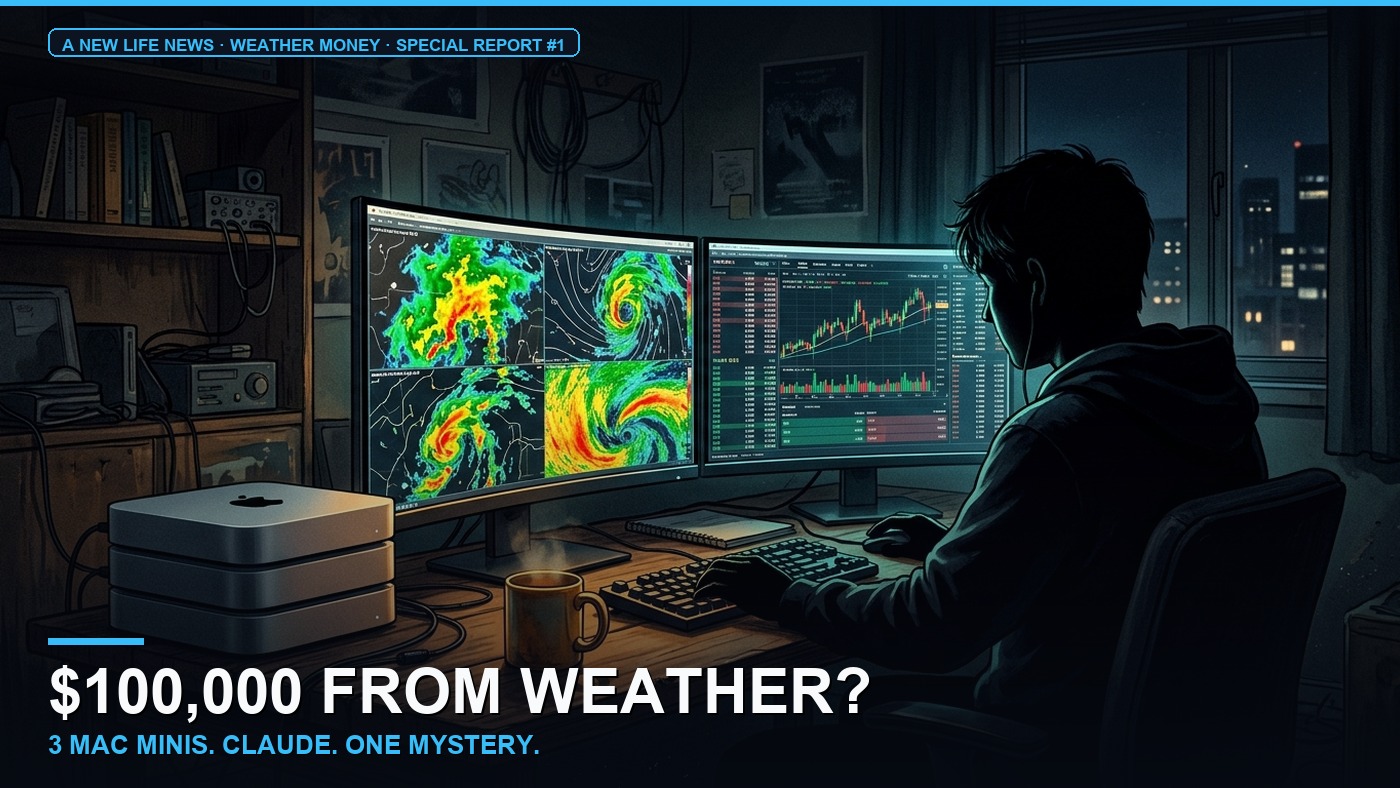
While half the internet stared at five-minute Bitcoin candles, agonized over Federal Reserve rate cuts, and argued about dog-themed memecoins, three silver Mac minis were quietly humming on a cramped wooden desk. Two monitors glowed in the dark. And an AI workflow powered by Claude worked through the night with a single obsession: comparing meteorological telemetry against prediction market odds — and turning tomorrow’s air temperature into cold, hard cash.
At least, that is the story that detonated across X and algorithmic trading chats over the past week.
In the viral posts, the scene reads like a cyberpunk sequel to The Social Network. According to the narrative, a university student in China built a compact autonomous weather-trading station right in his dorm room: he wired open meteorological feeds into local scripts, used Claude to analyze discrepancies between official weather forecasts and daily temperature brackets on Polymarket, and let the machine compound small edges around the clock.
The detail that made the post legendary? The roommate. For weeks, the story goes, his roommate walked past the stack of humming Apple boxes without a second glance — until he accidentally glimpsed the terminal screen showing over $100,000 in cumulative profit. After a long silence, the roommate reportedly asked a single question: "Hey… do you think we can fit one more monitor on this desk for me?"
Sounds almost too cinematic to be 100% literal? Good instinct. At A NEW LIFE News, we love a great narrative, but we trust verifiable ledgers even more. So we split this mystery into two parts: what remains unverified internet folklore, and what is permanently etched into the public blockchain right now.
Separating Dorm-Room Folklore from On-Chain Reality
Let’s start with a cold shower for the romantics. None of the viral reposts circulating on X provide a verified name, university ID, or cryptographic signature linking a specific dorm room in China to a blockchain wallet. The three Mac minis (which, frankly, is overkill for a Python pipeline that could run on a single cloud VM), the two monitors, and the stunned roommate are classic internet myth-making — impossible to confirm without the operator stepping forward.
Here is the twist, though: when you look past the dorm-room anecdote and audit the actual ledger on Polymarket, the real story isn't weaker. It is ten times more fascinating.
Because the Polymarket profile at the center of the viral threads — an account named ColdMath — is 100% real.

Inside the ColdMath Ledger: $101,042 Built One Degree at a Time
Pull up the public transaction history for ColdMath on Polymarket and you don’t see a lucky gambler who YOLO’d tuition money on a single hurricane. You see the unmistakable footprint of an automated quantitative machine:
- Verified Net Profit (PnL): Approximately $101,042 in cumulative realized gains.
- Sample Size: More than 5,000 predictions and trades. Across five thousand executions, blind luck evaporates — this is systematic expected-value harvesting.
- Target Markets: Daily Highest Temperature (
Tmax) brackets across major global aviation hubs — New York (KJFK), London (EGLC), Chicago (KORD), Seoul (RKSI), and beyond. - Asymmetric Payoffs: The ledger is packed with surgical entries into mispriced temperature buckets at 5¢ to 25¢ per share that settled at $1.00 once the airport thermometer locked in the daily high.
Look closely at how those trades behave. A casual retail trader treats a weather market like a sports bet: they glance at the default weather app on their iPhone, see "London 18°C tomorrow," and buy the 18°C bracket.
Whether the operator behind ColdMath is a brilliant student in a hoodie, a solo indie developer, or a compact quant desk, their script plays a completely different game. It doesn't trust a consumer phone app. It sweeps up underpriced adjacent temperature brackets during the exact window when multi-model meteorological ensembles and live airport sensors have already shifted the probability curve — while human traders in the order book are still asleep.
Why Everyone Is Debating the Mac Minis and Missing the Real Revolution
The debate over whether ColdMath really sits in a dorm room with three Apple boxes is a classic distraction. While commenters argue about hardware, they miss the real financial story of 2026:
Prediction markets have turned atmospheric physics into a liquid, tradable asset class.
Unlike Bitcoin or tech stocks, the troposphere doesn't care about Federal Reserve speeches, insider leaks, or 3 a.m. billionaire posts on X. You cannot pump-and-dump a cold front over the North Atlantic in a Telegram group. What you can do is measure it using numerical weather prediction ensembles, live METAR aviation telemetry, and a disciplined AI probability engine.
So how does that engine actually work under the hood? How do Polymarket temperature brackets price probability? Why do airport METAR reports and Weather Underground rounding rules create hidden arbitrage windows? And most importantly — can you build a research system like this yourself on a free cloud server without buying a single Mac mini?
Can You Build a Weather Quant Engine Yourself — Without Three Mac Minis?
In Part II of our WEATHER MONEY series, we open the black box: how Polymarket temperature buckets work, how live airport METAR telemetry beats consumer apps, how ECMWF / GFS / ICON ensembles turn degrees into probabilities, and how we designed the WEATHER EDGE AI research prototype for an Always Free Oracle Cloud server.
Read Part II: "Claude vs. the Weathermen: How AI Finds Money Inside Weather Forecasts" →