In Part I of our WEATHER MONEY investigation, we examined the phenomenon of Polymarket’s ColdMath profile — an automated strategy that logged over 5,000 trades on daily air temperature and racked up more than $101,042 in net profit, sparking a viral legend about a dorm room, three Mac minis, and Claude.
Strip away the midnight campus mythology, however, and a much bigger engineering question remains: how does an algorithm actually extract money from a public weather forecast? After all, tomorrow’s temperature in New York, London, or Seoul isn't classified state intelligence — it sits for free on every smartphone screen on Earth.
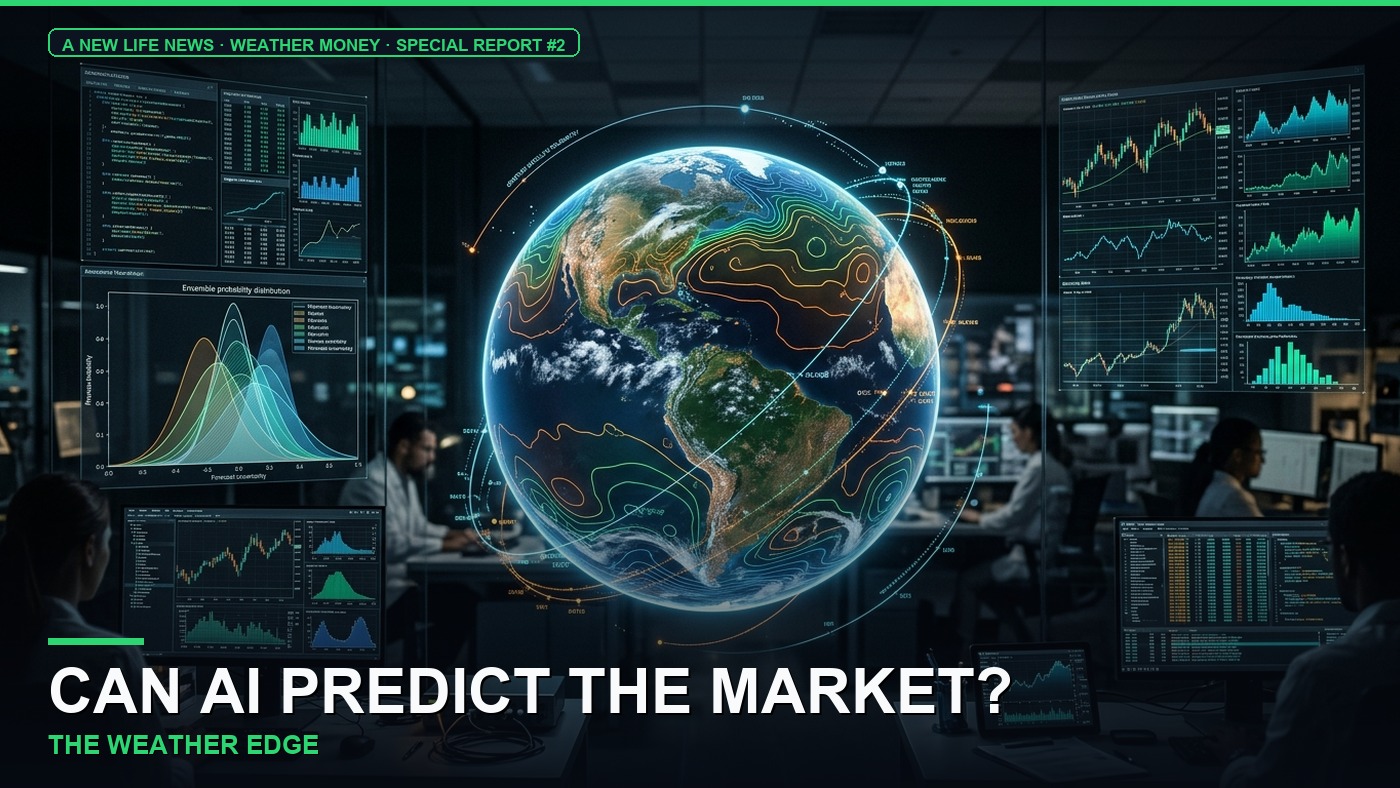
The secret is that your phone’s weather app and a prediction market order book speak two completely different languages. Your phone gives you a single deterministic number. A prediction market trades a probability distribution. And inside the gap between those two worlds lies one of the cleanest quantitative edges on the internet.
1. How Polymarket’s Daily Temperature Roulette Works
Every day, Polymarket lists Highest Temperature (Tmax) contracts for major global cities — New York, Chicago, London, Seoul, Toronto, Buenos Aires, and more. The market slices tomorrow’s possible daily high into narrow mutually exclusive buckets of 1°C (or 2°F).
Imagine a mild afternoon approaching London City Airport. The order book prices each degree bucket between $0.01 and $1.00, directly reflecting market-implied probability:
19°C or below— trading at $0.06 (6% implied odds)20°C— trading at $0.28 (28%)21°C— trading at $0.44 (44%)22°C— trading at $0.17 (17%)23°C or higher— trading at $0.05 (5%)
At midnight local time, the binary settlement rule is ruthless: one winning bucket pays out $1.00 per share, and every other bucket goes to $0.00. If your calibrated model calculates that the true atmospheric probability of hitting 22°C is 42% while the market offers it at 17 cents, buying that bracket captures massive positive expected value (+EV) over hundreds of repetitions.

2. Why Your Phone App Loses: ECMWF, GFS, and ICON Ensembles
When you glance at a consumer weather app and see "Tomorrow: 20°C," you are looking at a smoothed average designed to help commuters pick a jacket. Supercomputers don't think in single numbers.
Modern meteorology runs on Ensemble Numerical Weather Prediction (NWP) systems:
- ECMWF (European Centre for Medium-Range Weather Forecasts): Widely considered the global gold standard, running a 51-member ensemble where slightly perturbed initial conditions map the full spectrum of atmospheric outcomes.
- GFS / GEFS (US NOAA Global Forecast System): A 31-member ensemble updating four times daily (00, 06, 12, and 18 UTC) that quickly catches fast-moving North American frontal shifts.
- ICON (German Weather Service DWD): High-resolution regional physics that excels at modeling low-level cloud cover and surface solar heating.
When an algorithmic pipeline pulls all 80+ ensemble members via an open API like Open-Meteo for the exact latitude and longitude of an airport runway, it sees shifts hours before retail traders do. For example, if afternoon cloud cover thins out in the latest model run and 38 out of 51 ECMWF members jump from 20°C to 21°C, the consumer phone app often lags behind — leaving the 21°C bracket on Polymarket temporarily mispriced.
3. The Intraday Weapon: Live Airport METAR Telemetry
Ensemble models generate edge 12 to 36 hours ahead of settlement. But the sharpest mispricings happen on the day of the contract itself, between 11:00 a.m. and 4:00 p.m. local time, right as solar heating pushes the thermometer toward its daily peak.
That is where METAR (Meteorological Aerodrome Report) aviation feeds take over. Polymarket weather contracts don't settle on "downtown vibes" — they settle on specific airport weather stations identified by four-letter ICAO codes:
- New York — LaGuardia (
KLGA) or JFK International (KJFK) - London — London City Airport (
EGLC) - Chicago — O’Hare International (
KORD) - Seoul — Incheon International (
RKSI)
Automated airport sensors (ASOS) broadcast fresh METAR strings every 30 to 60 minutes (plus unscheduled SPECI alerts when weather shifts rapidly). Even better, US METAR reports include a remarks section (RMK) containing a T-group code such as T02170144 — revealing the exact sensor temperature to a tenth of a degree Celsius (+21.7°C) before standard whole-degree web tables even refresh.
4. The Devil in the Settlement Rules: Weather Underground & Market Friction
Does that mean anyone can hook METAR up to an LLM and print effortless profits? Not quite. Nine out of ten copycat bots blow up because they ignore four real-world frictions:
| Friction Factor | Naive Assumption | Hard Market Reality |
|---|---|---|
| Official Resolution Source | Any official city thermometer | Strictly the Weather Underground historical station page for that airport code. Whole-degree rounding rules decide every $1.00 payout. |
| Order-Book Spread (CLOB) | Instant fills at mid-market price | Thin liquidity in adjacent brackets creates 4¢–8¢ bid-ask spreads that erase naive theoretical edges. |
| Microclimate Reversals | Smooth afternoon warming curve | A sudden afternoon sea breeze at KJFK or passing cloud deck at 2:30 p.m. can cap the daily high 0.4°C short of the next bucket. |
| Variance & Bankroll Risk | "AI knows tomorrow's weather" | Even a true 70% probability loses 30% of the time. Only fractional position sizing across hundreds of markets survives. |
5. Introducing WEATHER EDGE AI: Why Buy Three Mac Minis When We Have Oracle Cloud?
Here is our favorite takeaway from this entire investigation. When our engineering team audited the actual compute footprint required to run a multi-model weather probability pipeline, one fact became obvious immediately: you do not need three Mac minis sitting on a desk.
Polling weather ensembles, parsing live METAR strings, reading Polymarket’s order book, and running AI probability calibration takes a fraction of a single CPU core. Better yet, we already have an Oracle Cloud Always Free environment where a clean research prototype — WEATHER EDGE AI — can run 24/7 at zero hardware cost.
We designed WEATHER EDGE AI as a strictly read-only analytical & paper-trading research lab (with zero live money at risk) built around four modular services:
- Weather Ensemble Ingestor: Polls
ECMWF,GFS, andICONensemble distributions via Open-Meteo alongside live ICAOMETARreports every 15–30 minutes. - Market Odds Scanner: Takes read-only snapshots of Polymarket CLOB order books for active daily temperature brackets, recording bid, ask, mid-price, and book depth.
- AI Calibration Core: Applies station-specific bias correction and compares model probability against market-implied odds (
Edge = P_model − P_marketnet of spread). - Paper-Trading Audit Ledger: Logs virtual test signals before market close and scores real-world accuracy (Brier score & virtual PnL) once official Weather Underground settlement posts.
Follow the A NEW LIFE News Weather Lab
Our engineering blueprint for the WEATHER EDGE AI Oracle Cloud research lab is ready. In upcoming episodes of WEATHER MONEY, we will test where crowd pricing makes its biggest systematic mistakes — from London’s volatile maritime microclimate (EGLC) to New York’s coastal sea-breeze fronts (KJFK).
Editorial Disclaimer: This investigation is published strictly for journalistic, analytical, and educational purposes and does not constitute financial, trading, or wagering advice.
← Back to Part I: "Three Mac Minis, Claude, and $100,000 From the Weather"